

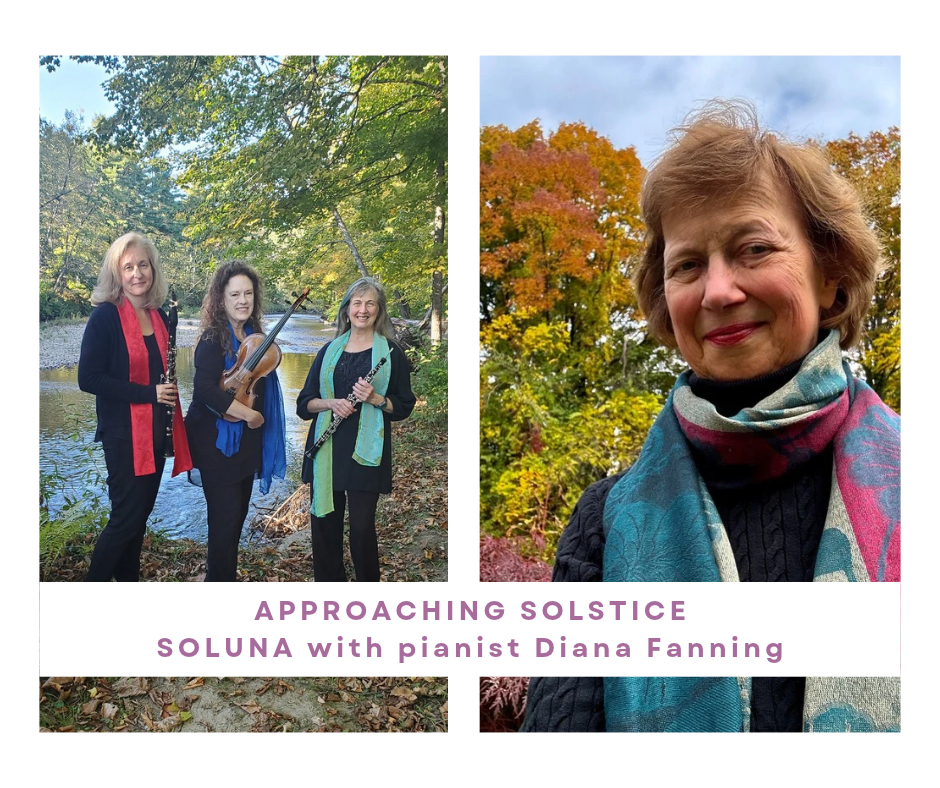
Saturday, December 5th at 7PM
The newly formed North Country music collaborative SOLUNA, as the name implies with its combination of “sun” and “moon,” thrives on the balance and unity of differences. Soluna performs music from Baroque to avant-garde in diverse instrumental combinations, and is actively committed to outreach presentations designed to attract new audiences. Middlebury College Guest Artist Diana Fanning will join Janice Kyle, oboe, Janine Scherline, clarinet, and Patricia McCarty, viola, in a delightfully mixed program ranging from Mozart to Modern.
The concerts have an evening and matinee performance, Saturday, December 5th at 7PM and Sunday, December 6th at 3PM. Doors will open 30 minutes before the performances, and we recommend arriving early to avoid check-in lines. Admission for concerts at Elizabethtown’s Historic Hand House is $20, with a special $5 rate for children 15 and under. We accept cash or check and seating is on a first-come, first-served basis. Reservations are strongly encouraged due to limited availability. You can reserve your spot via email at pianobynature@gmail.com or by phone at 518-962-8899.

The Program
Trio in E-flat major, K. 498 “Kegelstatt” — W.A. Mozart (1756-1791)
Andante
Menuetto – Trio
Rondeaux. Allegretto
Divertissement, Op. 107 — Louis Durey (1888-1979)
Animé
Lento
Très animé
Sonata in F minor, Op. 120, No. 1 — Johannes Brahms (1833-1897)
Allegro appassionato
Andante un poco Adagio
Allegretto grazioso
Vivace
Intermission
Duetto in C major — Josef Fiala (1748-1816)
Allegro maestoso
Adagio
Fantasiestücke, Op. 73 — Robert Schumann (1810-1856)
Zart und mit Ausdruck (Tender and with expression)
Lebhaft, leicht (Lively, light)
Rasch und mit Feuer (Quick and with fire)
Introduction and Dance — Michael White (1931-2022)
Adagio espressivo
Program Notes
Mozart wrote the so-called “Kegelstatt” Trio for Clarinet, Viola and Piano, for Franziska von Jacquin, his favorite piano student, and Anton Stadler, friend and one of history’s first clarinet virtuosi. For its premiere, Mozart himself played viola. Stadler’s playing inspired Mozart to compose this trio, then the quintet, and later the clarinet concerto. The trio’s nickname originated in stories that Mozart composed music while playing an outdoor bowling game the Germans called “Kegeln” and “statt”, the place where it was played. “Composed while bowling” is inscribed on some of Mozart’s works for horn, but likely not this particular trio, which exemplifies Mozart’s often quoted remark that his music was sure to please “beginners and connoisseurs” alike.
Born into a middle-class family that owned a printing workshop, Louis Durey did not attend the Paris Conservatory, and instead earned a degree in engineering in 1908. He was inspired to teach himself composition after attending a performance of Debussy’s Pelléas et Mélisande. In the 1910s, Durey began to make a name for himself among young Parisian composers for his refined style. He was part of the French military for sixteen months during the First World War, barely composing during that time, though the war helped shape the socialist and communist political convictions he would champion throughout his life. In 1920 in Montparnasse, he joined the group of modernist composers that would be known as “Les Six” with Arthur Honegger, Francis Poulenc, Germaine Tailleferre, Darius Milhaud, and George Auric. Although they would remain friends, Durey chose to leave in 1922 because he did not share their taste for irony and levity, nor for the influence of music hall or jazz. In the 1930s, he joined the French Communist Party, and during the Second World War joined the Resistance, setting resistance and anti-fascist texts to music. After the war, Durey composed some film music, but mostly focused on works with political meanings, remaining outside the major currents of post-war contemporary music in his rejection of atonality, serialism or electronic experimentation. Divertissement, op.107, was written in 1966-1967 while he was living in Saint-Tropez. One of Durey’s last compositions, this work was never performed publicly during his lifetime, and not premiered until 1986.
In 1891, Johannes Brahms traveled to an arts festival in Meiningen where he was tremendously impressed by performances of the Weber Clarinet Concerto and Mozart Clarinet Quintet given by the orchestra’s principal clarinetist, Richard Mühlfeld. Compiling a truly remarkable professional resumé by today’s standards, Mühlfeld came to Meiningen in 1873 as a violinist, then in three years taught himself clarinet to a level of proficiency that he was engaged as principal, and in addition served as the orchestra’s assistant conductor. Their friendship led Brahms to compose the Clarinet Trio in A Minor and the Quintet for Clarinet and Strings during the summer of 1891, and the two Clarinet Sonatas, Op. 120, during July of 1894. In a letter to Clara Schumann, Brahms wrote of the Sonatas, “At 60, it would be high time to leave off…if you were to improvise a bit in F minor and E-flat major – you’d probably happen upon the sonatas.” With a few modifications of the clarinet part, Brahms arranged them for viola. These autumnal works have long been regarded among Brahms’ most deeply introspective music.
Prominent Bohemian composer Josef Fiala was born to a schoolmaster and a serf belonging to the estate of Countess Lobkowitz. He taught himself the oboe, but as a serf was compelled to menial labor, and eventually fled the estate in secret. He was recaptured, and out of spite the Countess notoriously ordered that Fiala’s front teeth be pulled out so he could never play the oboe again. Some of the nobility of Prague interceded for him with the Emperor, who commanded that he be set free, which allowed him to move to Germany and Austria where he became a close friend of Mozart. In Austria, Fiala held various positions performing oboe, violin, cello and even horn, and in 1786 he moved to Russia to work in the court of Catherine the Great. After returning from Russia, he toured Europe and performed viola da gamba for King Friedrich Wilhelm II. In 1792 he became Kapellmeister in Donaueschingen, where he spent the rest of his life.
Robert Schumann composed the Op. 73 Fantasiestücke swiftly over just a few days in 1849, a year in which he completed nearly 40 works, several with fanciful titles inspired by German folklore and literature. Originally for clarinet, it is often heard in cello, viola or violin versions. When Schumann and wife Clara traveled to Hamburg in 1850, the young Brahms sent a package of his compositions to their hotel. It was returned unopened, but after an introduction in 1853 in which Brahms played several of his compositions, Schumann wrote in his diary, “Visit from Brahms (a genius).” Within months of this meeting Schumann was overtaken by mental illness and entered an asylum where he remained until his death. Brahms and Clara Schumann remained close friends for the rest of Brahms’ life.
Michael White studied composition with Peter Mennin and Vincent Persichetti. He later taught at Oberlin, Philadelphia Musical Academy and Juilliard. This work, composed in 2015, concentrates on the differences and contrasting colors between the three instruments, with a slow, lyrical “Introduction” followed immediately by the fast, rhythmically exciting “Dance”, with constantly shifting meters, jazz inflections, and imitative counterpoint between all three instruments.
For a musical sample of Soluna, watch the video below of their June outreach performances with pianist Rose Chancler.
About the Artists
Janice Kyle, oboist, received her Bachelor of Music degree at California State University in Sacramento. She studied with Ben Glovinsky and Neil Tatman and followed up her B.M. with graduate studies in oboe performance at Indiana University with Jerry Sirucek. She currently continues oboe studies with Randall Ellis. Janice often enjoys expanding the oboe repertoire by borrowing works composed for other instruments. In Vermont, she has performed with the Vermont Symphony Orchestra, Burlington Oratorio Society, along with solo performances. She performs in various solo and ensemble venues in the Adirondacks including Soluna, Trillium Chamber Players, Adirondack Wind Ensemble, Champlain Valley Voices Orchestra, SUNY Plattsburgh Concert Choir Orchestra, and the Key Winds Trio. She has taught elementary music at Westport Central School and oboe performance at Plattsburgh State University. She enjoys cold, snowy winters skijoring with her dogs. Janice and her husband, Hans, the jazz saxophonist, (and the dogs!) live in New Russia, New York.

Patricia McCarty, violist, is devoted to the perhaps crazy notion of promoting the viola as a solo instrument, and performs repertoire from Bach to Keith Jarrett. She has appeared as soloist with the Detroit, Houston, Kyoto and Shinsei Nihon symphonies, Boston Pops, Orchester der Beethovenhalle Bonn, l’Orchestre de la Suisse Romande, Valencia Turiae Camerata, and in recitals throughout the U.S., as well as Caracas, Sydney, and a highly acclaimed debut at London’s Wigmore Hall. Winner of the First Silver Medal and Radio Prize in the Geneva International Competition when she was eighteen, Ms. McCarty graduated the following year magna cum laude from the University of Michigan, where she studied with Francis Bundra. Former assistant principal violist of the Boston Symphony Orchestra, she has performed as chamber musician at the Aspen, Marlboro, and Tanglewood festivals. Her recordings of solo and sonata repertoire have received international accolades including Gramophone “Critics’ Choice” & Strad “Selection CD”, appearing on Ashmont, Northeastern, Equilibrium labels, and Keith Jarrett’s Bridge of Light for viola and orchestra on ECM. Ashmont has recently released Crossings, duos from Baroque to 21st century with guitarist Bill Zito, to international critical praise.

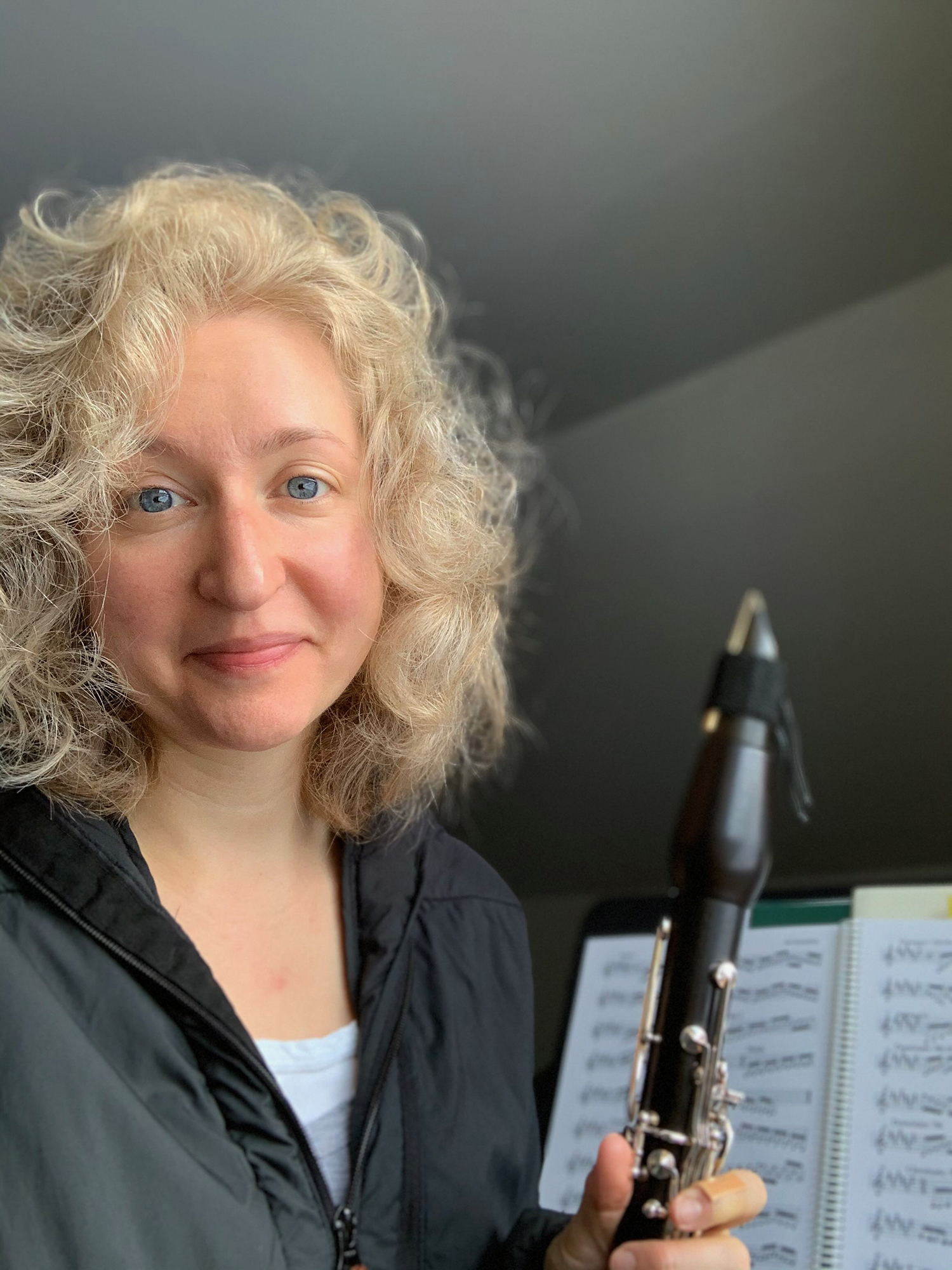
Janine Scherline, clarinetist, is a sought-after chamber musician, soloist and instructor of clarinet in the Adirondack region. She has performed at venues in Europe, Canada and the U.S., including Lincoln Center, and participated in numerous masterclasses and workshops with renowned clarinetists and pedagogues including Larry Combs, James Campbell, Howard Klug and Richard Stoltzman alongside his master teacher Kalman Opperman (d. 2010). Locally, she has performed with the Northern Symphonic Winds, Lake Placid Sinfonietta, Champlain Valley Voices, Trillium Chamber Players, Metamusic, and was a founding member of the Key Winds Trio. She is principal clarinetist of the Adirondack Wind Ensemble. Janine holds degrees from James Madison University, Ithaca College and has also studied at McGill University in Montreal. When she’s not practicing and performing new music for Soluna Ensemble, she enjoys working with dedicated people at the Adirondack Council, spending time with her husband Todd and their feline companions, and being outdoors whenever possible.
Special Guest Artist
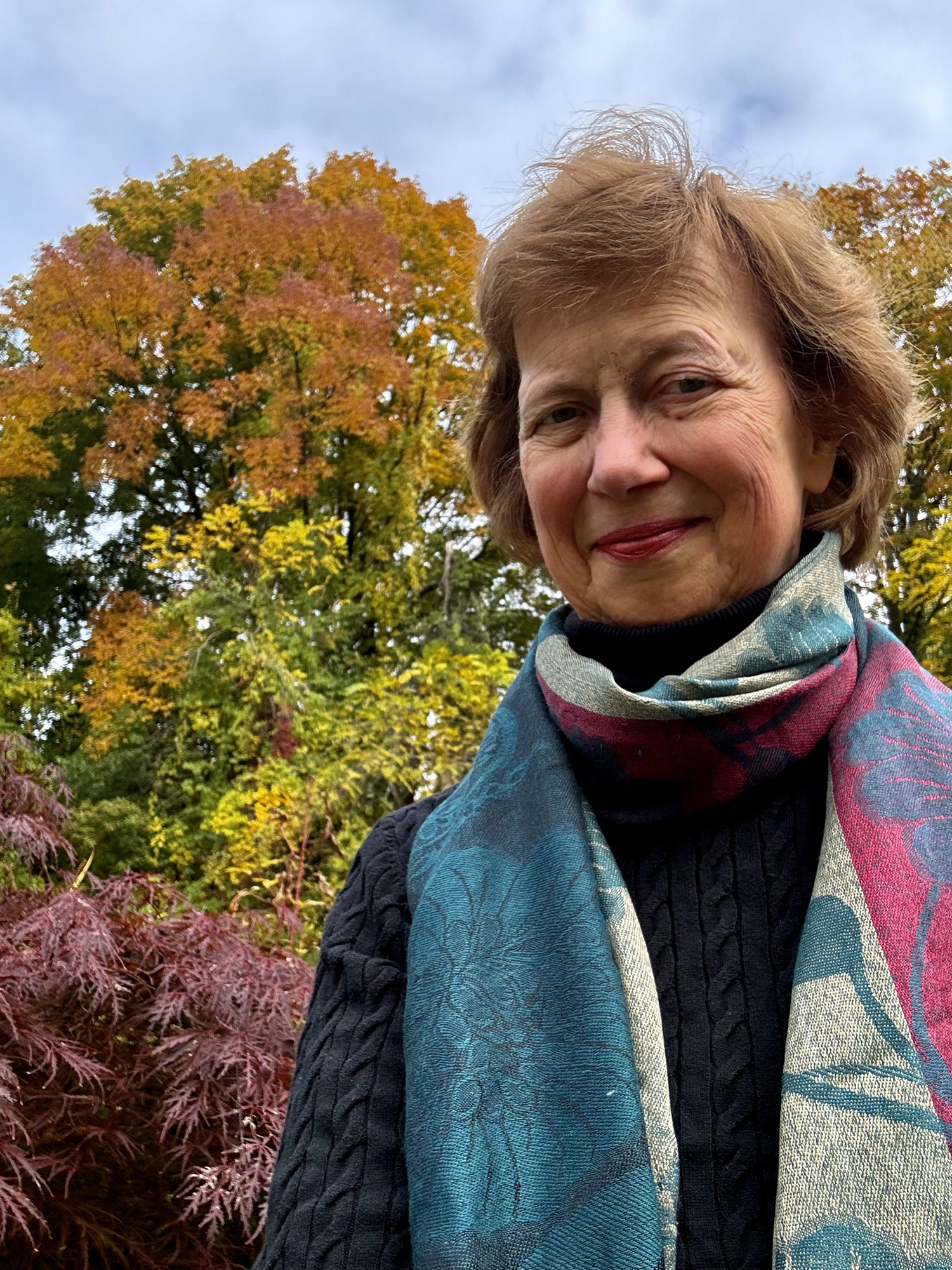
Diana Fanning has toured extensively as a recitalist and chamber musician throughout the eastern US and in Europe, concertizing in London, Paris, Geneva, Amsterdam, and Munich. After her first solo concert in Munich, a critic acclaimed “the effervescent brilliance and passionate sweetness of her playing” and added that “her virtuoso playing was rich in nuances.” She has performed numerous times as a concerto soloist with the Vermont Symphony Orchestra. Vermont Public Television featured her in a program of works by Scarlatti, Ravel and Chopin. Radio audiences throughout New England and Canada hear her frequently in live and taped performances over Vermont Public Radio, and she has also performed live on “Morning Pro Musica” (WGBH-FM) Boston and on WNYC, New York City. As a chamber musician, Diana Fanning has toured New England as a member of the Ruggieri Chamber Soloists and has performed widely with cellist Dieuwke Davydov. The Davydov-Fanning Duo has gone on concert tours of Europe which included recordings for Radio Netherlands and has been presented in a Carnegie Recital Hall debut by the Concert Artists Guild International Competition. Diana Fanning has been a guest artist with the Takacs String Quartet, with the Alexander String Quartet, with ensembles from the Vermont Symphony Orchestra, and with faculty members of the Point Counter Point Chamber Music Camp, which she and her husband Emory Fanning owned and directed for ten years. Her major teacher has been Ruth Geiger of New York City; she also studied at the Conservatoire National de Paris. Diana Fanning teaches piano at Middlebury College, Vermont.
Please consider sending a donation to Piano by Nature to help us continue to support our artists and deliver exceptional live music to the North Country and beyond. You can mail a check to Piano by Nature, 32 Champlain Ave., Westport, NY 12993. Or donate online through the Donate button below (using your Paypal account or credit card). If you have questions or ideas, feel free to call Rose at 518.962.8899. I’d love to hear from you.